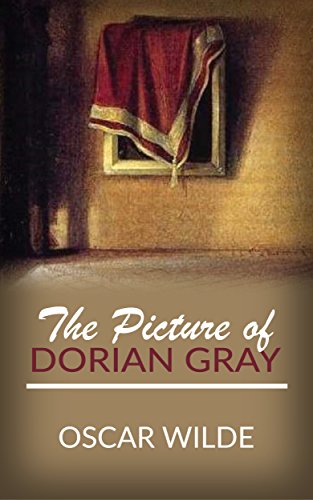
What happens when you take your conscience and hides it in a room?
In “The Picture of Dorian Gray” by Oscar Wilde, Dorian takes his picture, covers it with a cloth and hides it in a secluded room. Not to preserve it from deterioration, but because he can’t stand the sight of it. The reason Dorian was filled with so much hatred for the picture was because it had turned itself into a physical representation of his conscience. It wore the cruel expression on his face when he committed a grave sin against a sweet girl who loved him ardently. It wore the scars of his wickedness. It displayed the dark pleasures he sought. But It also gave Dorian immortality. It grew old instead of Dorian. It was only when Dorian looked at the picture he saw the real him. The picture was the true mirror for Dorian.
Foreword
From my reading, the Book makes a strong case for the objective existence of a conscience and also how morality is not subjective. In my earlier review I have remarked about how Lord Henry metaphorically represents the devil and I have expanded upon it quite a bit. Now I also make the claim that Dorian's Picture is actually his conscience. Given the nature of both these statements one could say that the Novel is a deep study of morality, through symbols and metaphors. So I have decided that I should examine the behaviour of Dorian towards the picture, in the hopes that it might help me to get a better understanding of behaviour of humans, those who sin in particular, towards their own consciences. Because as far as I can see we live in a deeply immoral world, where materialism has taken over and nihilism is the norm and objective morality has become a despicable term. So for me it would be beneficial to understand the reasons for this fall.
Characteristics of Conscience
I think I should begin first by looking at how the Picture is responding to Dorian's actions. Because if the Picture is really his conscience this will give us insights into the characteristics of the conscience. That is necessary to understand because there is notion that conscience of a man is a malleable property; As in, the conscience can undergo changes from external influences. Maybe conscience will evolve as the person grows more and more older. As the conscience progresses through the practical world, it would start to understand that, ideal are just that ideals and trying to live up to that is just wishful thinking. Therefore conscience decides to not use the only tool at it's disposal not so frequently anymore, i.e. the guilt. But this seems not so true in the context of the novel. Even though it is true that Dorian stopped feeling guilty most of the time when he was committing sin, this can't be attributed to the deterioration of his conscience. Because throughout the story whenever Dorian was in the presence of the picture or whenever he was contemplating about it he went through deep emotional states resembling of a man realising his sins and his reactions became more and more severe as time progressed, as his load of sins increased. Whether that be his reactions of shame, or of anger at the severe scrutiny that the picture imposed upon him or the ecstatic pleasure he had seeing his real self getting destroyed and scandalised bit by bit. His strong reactions indicate the ever-active nature of the conscience whenever Dorian was in front of it. We can also see that in the end when Dorian decides to do something relatively positive and comes in front of the picture, we can see that the picture is unchanged. As a reader we were confused at that point, but Dorian being the only one who can testify to his thoughts understood it's judgement against him. Even though Dorian fooled himself into thinking that he did something really praiseworthy and noble, the Picture saw right through him. The Picture scrutinised Dorian's action and found that the noble thing Dorian did was not out of a good heart, but out of his usual craving for noval feelings. From these incidents we can take away two things for sure, One being the consistent nature of the conscience and two being the independence of the conscience from the person itself. So conscience could be called an independent, consistent and objective moral judge.
This in turn shows us that the novel thinks moral subjectivity that Lord Henry was calling out for is in itself something bad and immoral. I make this statement in reference to a singular person. That is Moral subjectivity adopted by a singular person is not something that conscience condones. Dorians moral understandings was on a different trajectory altogether compared to the Picture, and his moral arguments were not even consistent most of the times but this never affected the conscience, i.e the picture. But in reference to people in different societies or different cultures, the moral subjectivity question has not been answered. Particularly because the story focuses on the relationship between Dorian and his conscience.
The question of where does this consistent objective morality originates from is also a question that has no answers in the book. It is written in the context of the Victorian era so it reflects most of the values of the time, even though most readers were confused by the messages the book was sending.
Comments
Post a Comment